











Wanna talk?
HairTalk® is the place for you!


Copyright 1997-2025, hairboutique.com, All Rights Reserved.




IntroductionI picked up a recent issue of a fashion magazine while I was stuck in the check out lane at the local Kroger. The cover page touted "Hair News 30 Looks You'll Love". How could a hair junkie like me NOT read an article with that title? I was pleased that I took the time to pick up the magazine. The title: Rave Waves, Curls & Crimps grabbed my eye. While waves and curls were very big for 1999, crimped hair was also a major hair happening. The article was based around the hair look for 1999, which was known as the "bed-head" look. To get this look, all you needed to do is look like you just hoped out of bed.
The late famous NYC stylist John Sahag of John Sahag Workshop, provided the magazine with some details on how to achieve a hair look that fearlessly flaunted the concept of hair that is totally "undone". The key for the "bed-head" look is to be as messy as possible. Sahag explained in the magazine that "the rumpled hair styles work for just about every type of hair". He pointed out that "crimping works best for straight hair". While curls and waves are considered romantic, texture adding crimping is considered edgy. Is crimping for everyone? Many stylists might argue that the "bed-head" look or the crimped look works best for younger hair. I would hate to put any limiting factors on any hairstyles, however, when it comes to crimping, the key is to evaluate every factor from hair type, texture and length to how the style meshes with your current image and age. The History Of Crimping
The modern crimping iron was specifically invented in 1972 by Geri Cusensa, the original founder of Sebastian, for Barbara Streisand's hair. The newly created "crimped hair" look was considered very hot and copied by many people. While it is possible that a form of crimping was used in other periods of history, the modern form was ushered in just for Barbara. In a sense, Barbara's crimped hair was a "look" just like Farrah's wings and Dorothy Hamil's wedge. The crimped look got a lot of attention and the newly invented crimping irons took their places on the shelves of major retail outlets right next to the curling irons.
Celebrity Bed Head Crimping Look
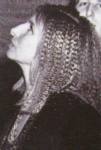
Besides Barbara, many celebrities adopted the crimped look at various times over the past several years. Jody Foster was a big fan of crimping in 1987. Because Jody has a tiny, oval shaped face with thin hair, crimping was a great look for her. Alyssa Milano was also a fan of crimping in 1987 when she was at the tender age of 14. Alyssa reportedly enjoyed the "steamy crimped hair look". The photo of Alyssa with her crimped hair is from the March issue of InStyle magazine. With her crimped hair She was a perfect example of "bed-head" hair. Alyssa no longer wears her hair crimped. The current star of the Bewitched series, Alyssa wears her hair in an every changing array of styles that range from super short to long. Crimping AlternativesCrimping can be used to create many different types of looks. Because crimping adds texture and fullness to hair, it works very well with thinner hair. If your hair is thick, crimping can make the hair look too big. You will have to judge for yourself whether crimping would work best in just selected areas of your hairstyle or as a total look. The ideal face shape for crimping is oval. Consequently small faces look good in crimped hair. Crimping StylesCrimping also looks great as an adjunct to a sleek ponytail. The three hairstyles below use crimping in a variety of different ways. The styles were taken from the book, The Hairstyle File by Jacki Wadeson. The Hairstyle File was copyrighted in 1990, but shows some original and inventive ways to add crimping to an existing hairstyle. Unfortunately, this great book is no longer in print.
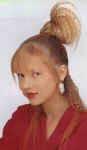
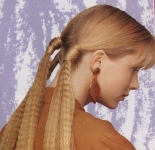
The first style to the right demonstrates crimping of just the ponytail. The bangs and the sides of the hair are left uncrimped. The hair is pulled into a half ponytail at the top of the head with some of the hair left hanging loosely at the nape of the neck. Crimping was done to all the hair in the ponytail. You also have the option to do crimping to the loose hair at the nape of the neck or the hair can be left straight. Multiple PonytailsCrimping is very versatile. You can crimp everything from your entire hairstyle to just selected parts of your hair. Crimping can be used on just the bangs, on just the top layer of the overall hair or at selected ends. Crimping also works well in a multiple ponytail style as shown below. In this style, three different ponytails are formed at the base of the neck. Strands of hair are wrapped around the ponytails and pinned securely. Then the loose hair in the ponytail is crimped from the top of the ponytail to almost the ends of the hair.
Since crimping may cause some breakage to the hair, it is best to avoid crimping the very ends of the hair. It is best to stop the crimping just above the ends. The multiple ponytail look can be modified to include more or less ponytails. The crimping can be done on alternating ponytails where one of the three ponytails might have crimping and the rest could be left straight. You also have the option to vary the amount of crimping that is done to the hair. Crimping can be done to just the bottom layer of the hair, the top layer of the hair or all of the hair. The advantages that crimping offers is that it adds texture and the ability to do a completely new look to your hair. The key to crimping is experimenting to find the look that is best with your face shape and current hairstyle. Any face shape can take advantage of crimping if it is applied wisely. Some face shapes can support an entire head of crimping, some shapes do best with only partial crimping. Crimping of the bangs will add texture and fullness to the front of your face while crimping of a topknot or ponytail will add height.
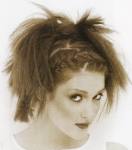
The crimped style to the right shows a hairstyle where the hair is pulled back behind the ears with the top hair gathered into soft ribbon ponytails that fall loosely. Only the loose hair at the bottom has been crimped. If you look closely, the hair is only crimped on the top layers with the bottom layers being left straight. The only thing that will limit you with crimping is your willingness to experiment. Orlando Pita matched hair that was tightly braided along the scalp (as shown below) with a "big hair" crimped look at the back of the head.
Orlando added some crimping to the top layers of the hair to give it a wild and partially curly, partially wavy look. The braids at the front of the hair are very small and placed tightly against the scalp. This photo was taken by Mario Testino for Glamour Magazine and was copied from Hair Style by Amy Fine Collins. Try Out CrimpingBefore you make an investment in a brand new crimping iron, you may want to "try crimping" on for size. You may want to ask your hairstylist to crimp your hair to see if you like the look. Or you can do a dress rehearsal by braiding wet hair into very small, very tight braids and then letting them air dry. When you take the braids out, you will have a similar effect to crimping. The advantage that crimping has over applying lots of little braids all over your head is the time factor. Also, unless the braids are all completely uniform, the crimped look will not be as even. A crimping iron provides a fast and easy crimped look that is more uniform. The down side to crimping vs little braids is that the crimping uses heat and may damage the hair more. A danger with braids is that if they are too tight against the scalp, over time, they can contribute to hair loss. One special advantage to crimping is that you can always wash it out with just one shampoo. Of course the same is true with little braids. Crimping Dos & Don'tsJust like a straightening or curling iron, a crimping iron uses heat to cause a temporary change to the hair's appearance and texture. It is best to use a crimping iron only on hair that is not damaged or prone to easy damage. While a crimping iron can provide a wonderful change to an existing hairstyle, it is in the best interest of your hair not to use it on a daily basis. It is best to use any hair care appliance that applies heat on an irregular schedule. DO
If your hair is more fragile consider using a leave-in conditioner that will also act as a heat protector (Phyto 7, Phyto 9) or similar. Always apply a "heat protection" product to your hair before you use a crimping iron. DON'T
If your hair is more fragile consider using a leave-in conditioner that will also act as a heat protector (Phyto 7, Phyto 9) Always apply a "heat protection" product to your hair before you use a crimping iron. How To CrimpIf you have analyzed your face shape, the condition of your hair and have figured out a great way to add crimping to your "look" follow these steps:
You can use the crimping iron everywhere. If you want more volume, use a volume enhancing shampoo and conditioner and apply a little volume gel to the roots of your hair before you begin to blow dry. SummaryThe "bed-head" look is always hot for hair. The messier your hair, the better. Although modern crimping has been around since the early 70s, crimping keeps coming back into popularity. Although crimping is generally adopted by younger people, anybody of any age, race or sex, can try crimping. However, it is important to make sure that your have a compatible face shape and hair that is in good condition. If you still want to crimp but want to avoid potential heat damage to your hair, be sure to limit the portions of hair that you crimp. You can go as lightly as just the bangs or go full out ala Barbara Streisand and have your whole hairstyle a mass of crimps. Social Media Network InformationPlease follow me on Twitter at: http://Twitter.com/HairBoutique. I look forward to meeting new people Thank you for visiting us at The HairBoutique Blog and for leaving your comments. They are very much appreciated. We apologize in advance but must remove any direct advertisements or solicitations. Original Publication Date: 1999 - Revised Publication Date: 05/22/10 | |||||||
| Send this page to a friend.. | |||||||
| If you want to talk more about this or other hair care articles on HairBoutique.com or anywhere else, please post a message on HairBoutique.com's Hair Talk Forums.
|
Please follow us on Twitter at: https://Twitter.com/HairBoutique. I look forward to meeting new people from all walks of Twitter and learning from their Tweets.