


Wanna talk?
HairTalk® is the place for you!
Copyright 1997-2025, hairboutique.com, All Rights Reserved.




Introduction
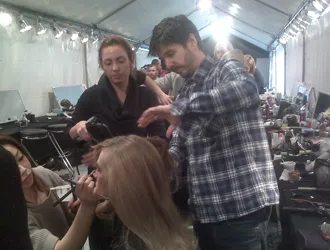
Famous celebrity hairdresser Ken Paves told me a few years back that one of the biggest challenges most hair consumers face is learning to work with a blow dryer and a brush at the same time. He reminisced standing in the back of a very famous hair salon in New York and watching customers struggled with the blow dryer and various brushes with varying results. Celebrity hairdresser Robert Hallowell (Courteney Cox, Lucy Liu, Geena Davis, Jennifer Love Hewitt, Jon Cryer) agreed with Ken on this point. Robert pointed out "when he is in the hair and makeup trailer on a film or TV set, he doesn't have much time to blow dry his celeb clients". Over the years Robert has confided "he has developed lots of little shortcuts for perfect blow outs". Of course Ken also has lots of shortcuts. It is important for consumers to understand the difference between a blow out performed on their hair by a skilled and experienced professional versus a blow out performed on their own head. Both Ken and Robert stressed the importance of hair consumers using the proper tools and techniques to achieve the best possible blow out results.
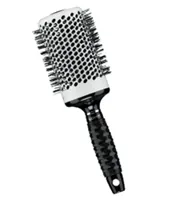
I agree and go one step further. After years of experimentation with all types of styling products, blow dryers, attachments, brushes and combs, I discovered my own very unique way of blow drying my tresses that works best for me. I encourage every consumer to find their own way. Meanwhile, this article covers the various types of brushes hair care professionals and hair consumers might use on their strands in conjunction with a blow dryer. Brush up on the following points before blow drying: 1. Hair Care Professionals have varying opinions about which brushes are the best for creating different blow out hairstyles. 2. Brushes should be selected based on hair type, texture, condition, length and styling goals. 3. Always keep your brushes and related blow drying tools clean. Keep in mind that oils and dirt can build up on the hair styling tools inadvertently being transferred back to your newly cleaned hair. 4. Never use brushes on wet hair to de-tangle. Hair is most fragile when wet and can rip an tear easily. Always start with a wide-toothed comb, pick or your fingers. You can use a brush to style hair after partially drying tresses to remove some of the initial moisture. General Brush ScoopsEvery year my Conair brush rep stops by for a long visit and explains in detail the pros and cons to every brush they carry. Trust me, Conair makes tons of brushes so Anna (who is wonderful) hangs around for awhile. Yes, I also love my Mason Pearson mixed bristle and Popular brushes but I also have some Conair brushes that are Boar's head inspired and I adore them. It is true that you get what you pay for but on a budget I can not speak highly enough about Conair and their fabulous brush line. Do I use a brush when I blow dry my hair? Truthfully I rarely blow dry my own hair because of its extreme long lengths. I also have learned that when I do blow dry, I get better results with my hands and fingers. My hair texture is naturally wavy and thus I can touch my damp strands without any repercussions. People with natural curls might not be able to do the same thing. Different Types Of BrushesAs Conair's Anna has explained to me numerous times, brushes are evaluated according to the following factors: 1. Size of the brush head 2. Brush handle 3. Weight of the brush 4. Function of the brush (to straighten, curl or style). The following brushes have a very specific purpose: 1. Paddle Brush 2. Round Brushes 3. Vent Brushes - Paddle or Round 4. Styling Brushes 5. Thermal Brushes The Paddle BrushThese are distinguished by their size and cushion type base from which the bristles protrude and are larger and flatter than the cushion brush and are used when you have lots or long hair to deal with. They are great to smooth naturally straight hair or to finish off after using a round brush to straighten frizzy, wavy or curly hair . Simply sweep the brush down the length of your hair with a paddle type motion. This way you won't create volume or highly stylized looks with this type of brush. Round BrushesThe name "round brush" describes itself but the most important thing to realise about it is that it's not just for creating curl. The more open bristle type is used for achieving maximum height and lift. The densely packed real bristle round brush is great at smoothing and straightening your hair with the tension needed for hair that naturally has a wave or curl. The size of the brush you need depends on the length of your hair and the effect you want. Your hair needs to be long enough to rap around the brush once. As a general guide: These are only rough guides and for all our brushes they we stock are classed small, medium and large for a simple choice for your needs. For short hair the head of the brush should be 1" in diameter or less. For medium length hair the head should be 1 to 1 1/2" in diameter For long hair the brush head should be a minimum of 1 1/2" in diameter and can range all the way up to 12 inches in diameter. More On Round BrushesRound brushes come in every imaginable diameter. They were originally invented to be used with blow dryers to add body curves, waves, curls and volume to straight hair. One common misconception about round brushes is that they are only used to create texture. Round brushes, when used correctly can also help to straighten wavy or curly hair. Depending on the density of the bristles, a round brush can achieve the following results: 1. Loose open bristles or vented round brushes (yes those exist) can create curls, waves as well as achieving maximum root lift and volume. 2. Tightly packed bristles are best used for overall smoothing and straightening. The compressed bristles built into a round brush will provide necessary tension for hair that has natural texture like waves or curls. The actual diameter and size of a round brush should be carefully keyed to the type, texture and length of the strands and the final styled effect. Your hair needs to be long enough to rap around the brush once. To get it right with a round brush:
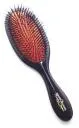
If you have tried a round brush and it failed to straighten your hair effectively there is this great new brush on the market that is easy to use at home. It looks like a pair of tongs with bristles facing towards each other. You simple clasp a section of hair near the scalp between the bristles and then dry your hair as you slide the brush through the hair towards the ends. Vent BrushSo called due to the open "vents" through which air can flow. It's used to create root lift and volume for your hair and to give some direction and movement like flicking out the ends of your hair. If your hair tends to be a little flyaway or static this is not the styling brush for you as it is the simplest brush to use but gives only the simplest of effects, as it is not far removed from using your fingers to dry your hair. It is a great brush for easing out tangles on medium to thick hair and men's or children's short simple styles or to give a little more height and lift to a style that you might normally dry with your fingers. StylerStyling brushes are all-purpose brushes that usually have six to nine rows of straight tufts of bristles. "Denman" is a brand name often used to describe this type of brush. They have no vents and a solid cushion backing. The bristles are on one side only and form a slight half circle bend. They are best used on bob shape cuts and mid length hair to achieve a little root and to smooth and straighten the lengths and ends of the hair. Like the vent brush, they are easy to use, but if you can't get the smoothness you want form this type of brush it is because it cannot provide enough tension that is lacking and you will need to use a large round bristle brush. Cushion BrushThese have a soft cushion base with bristles on one side, often slightly curved and are used to smooth, without lift or volume, short to medium hair lengths that aren’t too thick or dense. They are very simple to use and are popular with men to create neat smooth shapes without creating lift. Thermal BrushNot a brush type but a version really. You most commonly find round thermal brushes but they also come as vent or styler types. If time is your concern then a thermal brush could be what you need. They work by using a metal or heat conductive material as the center of the brush, this gets hot using the heat from your hair dryer. Therefore as you increase the heat that is drying your hair it will be working not only on the surface of the hair, but internally as well. You can get effects that are rather like setting your hair on rollers when you get really good with one of these! Be very careful though, it is easy to scorch your hair if the brush gets too hot! We would recommend that if your hair is fine, chemically treated or damaged that you use a good old-fashioned non-thermal brush and not a thermal brush. Ken Paves always "uses mixed bristle brushes when he blows out his celebrities". Ken owns several Mason Pearson brushes which are famous for being hand made of pure boar bristles which have a minimum risk of tearing your hair or causing damage or static. Mason Pearson brushes are expensive but worth every penny and will last for many years. They are actually good for your hair. Any brush that contains a high percentage of boar bristles with a mix of nylon are good whether flat or round. Dangers of Using Thermal Brushes - Especially Ceramic BrushesMany Thermal Brushes, especially the ceramic ones, will heat up very quickly and can get unbelievably hot. Some consumers have reported getting burns on their necks, ears and face from the very hot brushes. Avoid placing hot brush on unprotected legs and watch your hands and fingers when using them. Protect furniture with hot pads to prevent burn marks on furniture. The Ceramic BrushCeramics to most of us mean plates and bowls but some bright spark got the idea that certain types of ceramics retain heat and as such would help us to dry and style our hair. Previously various metals have been used as the centers for brushes and the plates of flat irons and tongs but as many of us know to our detriment we can over do it and burn our hair. It turns out that by replacing the metal with ceramics it not only does the job better but is less harmful to the hair. Using a brush with tips or balls on the end may scratch the scalp causing all sorts of problems. When possible, avoid using a brush that has balls on the tips or only use very soft tips that will not scratch the scalp. Beware of imitation brushes made of plastic which tend to break easily and fall apart. The size of the brush really depends on the length of your hair. Fine hair should use a brush that is small to give more support. The smaller the brush, the greater the root lift. Look for bristles that are more open and not close together to allow air to penetrate and heat the strands. When use a round brush, each section should be less than the width of the brushes to avoid tangles. Cleaning brushes if very important and can be done by using a second bristle brush in a cross section. Don't soak wooden brushes in water but rinse and use a brush or comb to take out any build-up. Shampoo can be used to wash bristles. SummaryChoosing the right brush for blow drying is half the battle.
| |||
| Send this page to a friend.. | |||
| If you want to talk more about this or other hair care articles on HairBoutique.com or anywhere else, please post a message on HairBoutique.com's Hair Talk Forums.
|
Please follow us on Twitter at: https://Twitter.com/HairBoutique. I look forward to meeting new people from all walks of Twitter and learning from their Tweets.